For years, black aviation history, like most black experiences in America, has been relegated to the back pages of newspapers or to footnotes in books and journals.
These contributions do exist, however, a very small portion been formally chronicled and documented. Because of this, American aviation is often perceived as an exclusively white profession.
NEGRO AIRMEN INTERNATIONAL (NAI)
PRESENTS:
The 46th Annual Memorial Weekend Fly-In
“Operation Homecoming”
May 23, 2013 thru May 26, 2013
Calendar of Events
Thursday May 23, 2013
10:00 am Flight instructions Performed
Practice Flights/Flight lessons
Bi Annual Review will be perform
Cessna 172 checkouts
*Subject to early registration participation
2:00 pm Arrival and Registration Begins
Static Display
6:00 pm Seminar
Diabetes in African American Community
“A 21st Century Approach to an Age Old Problem"
Tuskegee University Engineering Department Auditorium
Luther Foster Hall
Friday May 24, 2013
8:00 amChief Anderson Breakfast
Kellogg Conference Center
10:00 am Registration for youth flights begin
10:30 am Youth flights begin
Tours of Tuskegee
National Park Service Tours(On the Hour Except for 12:00 pm)
Tuskegee Airmen National Historic Site
1616 Chappie James Avenue
(Admission: Free)
4:30 pmFAA Flight Seminar (Hanger 2, Moton Field)
7:30 pm Food and concert at the Field
Saturday May 25, 2012
6:30 until 8:00 amBreakfaston Your Own
9:00amKick off to the Fly-in
Fourth Annual Fly-in Parade (Downtown Square)
Mr. Joseph Calloway
46st Annual Fly-In officially begins
FLYING, FOOD, FROLICKING AND FELLOWSHIP
Live entertainment, DJ and Airplane Rides
Career Day Job Fair and
Military Recruiters
Meet Employers at Moton Air Field
Tours of Tuskegee Continues
Tribute to: Ed Gibbs, and C. Alfred “Chief” Anderson, The
Fathersof Black Aviation”, Trainers of the Tuskegee Airmen
Military Jet L-39 Salute to the Tuskegee Airmen
6:30 pm Free concert At the Field
Sunday May 26, 2012
6:30 untilBreakfast on your Own
12:00 pmChampagne Bunch begin
Conclusion OF 46th Annual Fly-In
Departure: COME JOIN US NEXT YEAR IN THE “CITY OF LEGENDS”!
N. Judge King made his dreams come true — and other people’s too
By James L. Stroud, Jr.
Contributing Writer
Dr. N. Judge King has always been fascinated with the idea of flying and owning an airplane, ever since he was a young man of 10 years. According to him, fear of flying was never a part of his mindset.
“When I told people that I got my pilot’s license in 1968, they were afraid that I was going to hurt myself,” says King. He’s currently 75 years young and still going strong, but he decided to stop piloting airplanes in 2001.
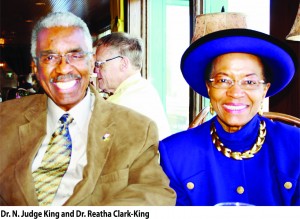
King has lived in the Twin Cities for more than 35 years with his wife, Dr. Reatha Clark-King, who is well known for her work as a former president of both Metropolitan State University and the General Mills Foundation. The Kings are both retired now, and in December of 2011 they celebrated their 50th wedding anniversary.
According to them, Judge came home one day in 1968 while they were living in New York and made a few announcements. The first was that he was going to get a dog, the second that he was going to get his pilot’s license, and the last that he was only going to be married 30 years and then he’d be done.
Reatha, pregnant with their second child at the time, replied, “Oh yeah? Well, when you leave, take both kids with you.” We’re not sure if there was a family dog, but we do know that the marriage is now into its 51st year and that Judge King has logged over 6,000 flight hours since getting his license.
King has made some significant markers as a pilot, flight instructor and business owner that have touched the lives of many African Americans interested in aviation over the years, and his contributions haven’t slipped “under the MSR radar,” so to speak.
MSR recently spoke with Dr. N. Judge King about his close ties with aviation in general and his membership with the Negro Airmen International (NAI), the oldest Black civilian aviation organization in the world. Formed in 1967, NAI has promoted the inclusion of African Americans in aviation through a number of programs, projects and educational activities.
King was born May 14, 1936; he is a native of Birmingham, Alabama. He graduated in 1957 from Morehouse College in Georgia, furthering his academic studies by also attending Atlanta University for his master’s degree and Howard University in Washington, D.C., where he received his doctorate in organic chemistry.
King worked as a college professor and chairman of the chemistry department for Nassau College in New York for 10 years, also teaching at Gallaudet College (now University) for the hearing impaired and Howard University, both located in Washington, D.C. He was employed for years with the 3M Company in Minnesota as a marketing manager for a product called Flexi-guard, and was the owner/operator of the American Air Center in Blaine, Minnesota.
The American Air Center (AAC) is no longer in operation, but for years King and his team of flight instructors made it their business to teach people how to fly, helping them earn their license qualifying hours using AAC aircraft. There was a special emphasis put into targeting people of color, African Americans in particular. King’s membership with NAI complimented his targeted outreach efforts. For six years, 1988 to 1994, he was NAI’s national president.
In the December 1988 issue of Ebony magazine, King was one of many Black aviators featured in an article entitled “Have Plane, Will Travel … Hundreds of Blacks are flying their own aircraft for fun and profit.” The picture of King showed him standing in front of his prized 10 passenger twin-engine Cessna 421 airplane — which he built himself — while talking on a hand radio to base operations during the NAI activities at their annual show in Tuskegee, Alabama.
Asked how he learned to build airplanes and how long it took him to complete the Cessna, King replied, “Oh, it took me about two years. Now as far as learning how to build them, you don’t have to be that smart to get it done.” He pulled out his iPhone and showed a video of him sitting in the airplane he built, the engine running as he prepares for takeoff.
Judge King and his wife recalled a time after the plane he built was complete and he showed it to his mother. She asked him, “How much will you take for it?” He asked why she wanted to know that. “So I can burn it up,” she said. “If God wanted us to fly, he would give us wings.”
Many of the NAI members were former Tuskegee Airmen, a.k.a. Red Tail fighters. King expects the recently released motion picture Red Tails might influence young African Americans to start signing up for flying lessons or join the military: “You always see that kind of thing happening after movies like that.” Some of the AAC/NAI members were among the first Black pilots hired by what was Northwest Airlines (NWA) and is now Delta Airlines.
Asked what Minnesota was like years ago for Blacks and what is different now, King said he sees a lot of progress and opportunity in many areas, but some of the same things are still going on in Minnesota and places like Alabama where he is from. One example came up in reference to the movie Red Tails, which was about the all-Black military regiment of pilots who were highly decorated, yet they were obstructed and denied the opportunity to fight for a long time. The irony is that the movie studios were reluctant to back the film financially because of the all-Black cast.
How can we get more African American teenagers to sign up for flying lessons? Judge King said, “Just tell them to go for it.”
Does he miss flying? “No, not really, because I put in a lot of hours in the air and traveled everywhere that I wanted to go.”
Reatha Clark-King added with a smile, “If he ever misses it, he can always watch that video of the airplane on his iPhone.”
Watch the video here
James L. Stroud, Jr. welcomes reader responses to [email protected].
NAI is a Membership Driven organization, where your donations and participation are needed in order that we may make the dream of flight available to others, so please send us your donations.
You may also make your Donations to NAI
(a 501 C(3) organization) NAI
P.O. Box 23911
Savannah, Georgia 31403